, Singapore
319 views

Singapore's 25 largest hotels 2013

Hotels face tight competition with around 2,500 new rooms coming onstream this 2013.

Marina Bay Sands has topped Singapore Business Review’s inaugural list of largest hotels in Singapore for 2013 based on the number of rooms.

The 55-story MBS, billed as the world’s most expensive standalone casino property at more than $6 billion, has a total of 2,561 luxury rooms and suites.

MBS has its busiest MICE month ever in October as it hosts 13 tradeshows and several key conferences. “The 13 tradeshows which attracted around 46,000 delegates, is approximately four times the monthly average since Sands Expo and Convention Center opened in April 2010,” MBS said in a statement. It posted a decent revenue per available room of US$362 in 4Q12 or a 10% rise from a year ago despite occupancy rate falling by 4 percentage points to 98.4.

“Performance-wise, 2012 was a banner year - from the nearly 70 awards we won, including the Best Foreign City Hotel from Condé Nast Traveler and ‘Best Business Event Venue Experience’ from the Singapore Tourism Board, to the high occupancy rate we sustained,” said president and chief executive officer George Tanasijevich.

Swissôtel The Stamford and Mandarin Orchard Singapore took the second and third spots with 1,261 and 1,051 rooms, respectively.

Swissôtel The Stamford and sister company, Swissôtel Merchant Court Singapore implemented a smoke-free policy on March 31 last year. With 1,261 and 476 rooms respectively, the Swissôtel brand boasts the distinction of offering the most number of smoke-free hotel rooms in Singapore. “As public awareness of the dangers of second-hand smoke grows, more guests are demanding a smoke-free environment. We hope to be able to create an impact, committing all 1,737 guest rooms in both hotels to this cause,” said Aiden McAuley, Swissôtel Hotels & Resorts’ regional president for Asia-Pacific.

Rounding up the top five are Carlton Hotel Singapore and V Hotel with 915 and 888 rooms, respectively.

The 790-room Pan Pacific Singapore which was renovated between April and October 2012, came in 6th. The hotel’s general manager Scott Swank disclosed to Singapore Business Review that a total of $80 million were spent for the renovation.

“Our key challenge, which was encountered and overcome, was the retention and redeployment of our over 500 associates during our Transformation,” said Swank.

Fairmont Singapore, another hotel under the Swissôtel brand came in 7th with 769 rooms. It edged out Shangri-la Hotel by only 19 rooms.

 Shangri-la boasts of its newlyrenovated Garden Wing, billed as Singapore’s only urban resort. The Garden Wing, which houses 158 guestrooms and suites, was reopened in June 2012 after an eight month- renovation. The S$66 million renovation also includes the creation of what it bills as Singapore’s first CHI spa and a new dining concept called Waterfall Cafe, said management.

Grand Hyatt Singapore landed at 9th place with 662 rooms. The hotel introduced an innovative restaurant- 10 SCOTTS last year which features areas for a library, dining, veranda and collection room.

Orchard Hotel Singapore, ranked 10th with 656 rooms, has also undergone a full refurbishment of its 331-room Claymore Wing.

Together, the 25 largest hotels have a total of 18,468 rooms or account for nearly a third of approximately 53,000 inventory of hotel rooms expected end-2012. Singapore’s largest hotels have 739 rooms on the average.


New supply

CBRE estimates a total of 2,400 rooms entering the market in 2012, possibly resulting in a 5.8% growth in the gazetted stock. CBRE adds that a further pipeline of 2,500 rooms is expected by end 2013 and hotel projects currently in planning stage could contribute another 2,400 rooms.

Year 2013 will welcome the opening of Ramada Singapore, Carlton Project , Connexion , Holiday Inn Express, Fairy Hill Point Hotel,Aqueen Lavender Hotel , Modena Frasers Suite, Sofitel Singapore, and Aqueen Geylang Hotel.
Join Singapore Business Review community
A NOTE FROM SINGAPORE BUSINESS REVIEW

The people you want to reach are already in this room.

Every quarter, SBR lands on the desks of the founders, CFOs, and directors running Asia's most consequential companies. Every day, they open our newsletter and read our website. It's a room that took twenty years to build — and it's the one most of our partners are trying to get into.

The good news is that the door is open. We work with companies on thought leadership articles, sponsored content, industry summits across Southeast Asia, regional awards programmes, podcasts, and media placements in print and digital. The shape of the right partnership depends on what you're trying to do, which is why we'd rather start with a conversation than send a rate card.


If you have something this room should know about, tell us. We'll tell you honestly whether we can help, and how.

No rate cards until we understand the brief. It's a better use of everyone's time.

Top News

AI shifting how wealth management solutions are built and delivered at scale
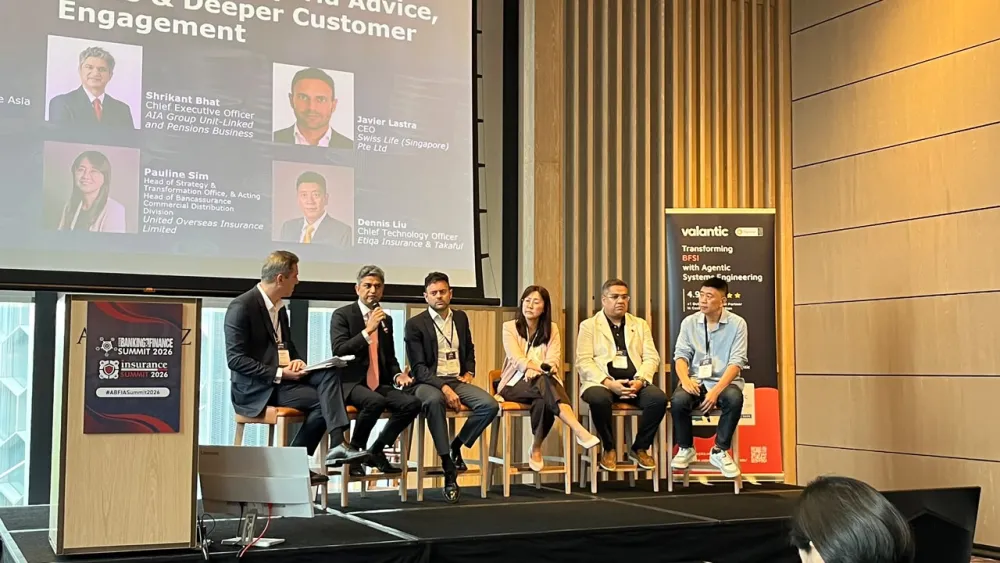
DBS aims to reduce investment insights preparation from hours to minutes using agentic AI.Artificial intelligence (AI) is changing wealth management economics by enabling advisers to serve more clients, not by replacing them, according to DBS Bank.The bank is using AI to automate time-consuming investment insights preparation to focus on building and delivering more personalised wealth solutions and recommendations at scale."We need to treat AI as the best personal assistant you'll ever have, and multiply that by 10," Wilfred Quek Siew Yih, managing director and group head of Wealth Management Solutions for Global Financial Markets at DBS Bank, said at the Asian Banking & Finance and Insurance Asia Summit held in Singapore on 1 July."It really removes your administrative frictions... so that you can concentrate on engaging and planning [with the] client from an emotional standpoint, whilst the AI does your portfolio analytics [and] looks at the client's profile,” he said.The shift represents a fundamental change in how wealth solutions providers operate. Instead of producing standardised portfolios for broad customer segments, AI enables advisers to tailor recommendations to individual clients."Gone were the days when you were coming up [with] a portfolio based on a generic segmentation view," Quek said. "Today, you can look into all these different aspects and deliver a very personal outcome for a client."Behind the scenes, DBS is deploying agentic AI to compress workflows that once took investment products teams several hours.Quek said his team previously spent mornings reviewing financial news, consolidating internal research, developing market views, generating trade ideas, pricing products and preparing presentation materials for clients—a process that "probably takes two, three hours easily across colleagues."The bank is now working to complete the same workflow in "10–15 minutes, including a maker-checker, human-in-loop process.""With that, you really can scale a business, and you can hyper-personalise," he said. Instead of producing a single market view once a day or once a week, we can now generate multiple personalised updates throughout the day, tailored to different clients and investment advisers, especially when markets are volatile.For DBS, the productivity gains are intended to expand employees’ capacity rather than reduce reliance on human expertise."The humans are here to stay," Quek said."AI is meant to enhance. Just imagine an adviser today who can talk to five clients because of the work they needed to do, versus tomorrow, where you can talk to 50 clients with the same granular attention you can give to your clients today."Even as AI takes on portfolio analytics and administrative work, Quek argued that human judgment remains central to wealth management."You wouldn't want AI to tell you everything you need to do and just execute a deal for you," he said. "End of the day, there's an element of emotional empathy, emotional intelligence."That philosophy also shapes DBS' approach to AI governance.Quek said the model will become increasingly important as banks compete for Asia's growing mass affluent segment, which he described as "one of the most underserved.""With that scale, you need AI to help you serve your clients," he said.Whilst digital capabilities continue to expand, Quek does not expect AI to eliminate the need for advisers or wealth centres.
Asia insurers risk irrelevance as protection gaps widen
An expert said Singapore saves 36% of its income despite having high protection and critical illness gaps.
Insurance
Banks urged to turn pricing into a strategic growth lever
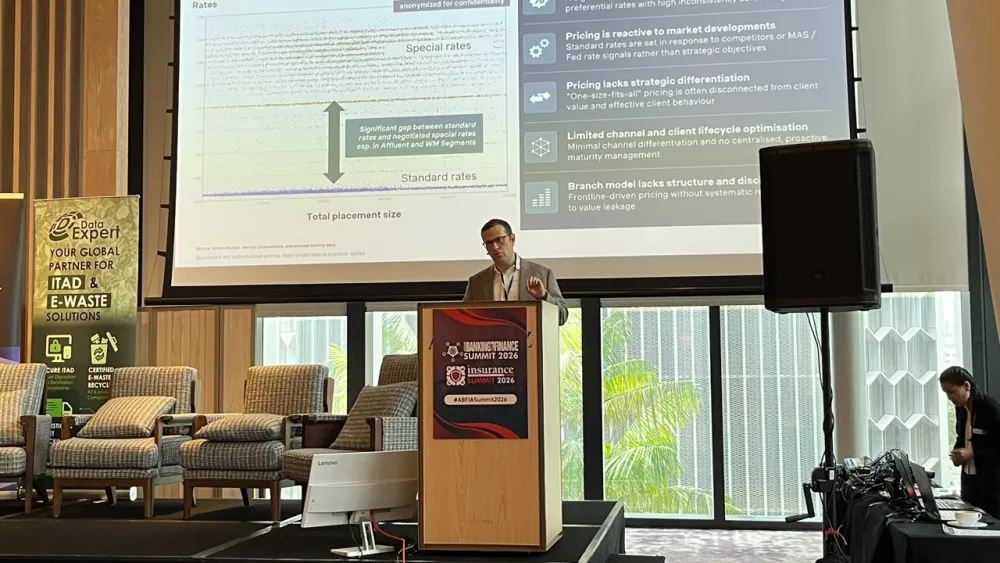
A consultant says data-driven pricing can boost revenue and lower funding costs without sacrificing volume.
AI governance failures threaten banks’ returns
95% of GenAI spend has no outcome as organisations remain in the early stages of adoption.