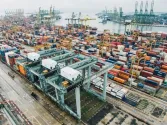
Why Taiwan's economic performance this year disappointed analysts
Structural woes dragged growth.
According to DBS, Taiwan's poor economic performance this year is reflective of structural problems, including the insufficient export diversification and the narrowing of technology gap with competitors.
Here's more:
Taiwan's export orders data will be released this Friday and the central bank will hold the quarterly monetary policy meeting next Thursday.
Export orders growth is expected to fall in the year-on-year terms in November due to a high comparison base (DBSf: -2.4%). Nevertheless, the central bank is still likely to keep the benchmark rate unchanged at 1.875%, staying on hold for the tenth consecutive quarter.
Admittedly, economic growth is weaker than expected this year and inflation is lower than estimated. The Directorate-General of Budget, Accounting and Statistics (DGBAS) recently cut the annual GDP and CPI forecasts to 1.74% and 0.94% respectively. According to the DGBAS, growth will remain lacklustre at 2.59% next year and inflation will stay tame at 1.21%.
To revive growth, there is not much the central bank can do, unfortunately. Interest rates have remained close to the 2009 lows and property prices have stayed at a multi-year high, sparking concerns about asset bubbles. Instead of providing monetary stimulus, the central bank recently has stepped up efforts to mop up excess liquidity in the financial system.
The outstanding NCDs issued by the central bank have increased from TWD 6588bn in end-Nov to TWD 6634bn in mid-Dec.
Industrial and trade policies are needed to address these issues. It seems that policymakers have also reached consensus in this regard. When the DGBAS downgraded GDP forecasts last month, structural drags were cited as the key reason.
The government recently has also decided to review the plan of Free Economic Pilot Zones, to include more liberalization measures in order to attract foreign investment in the value-added industries.
Regarding the Fed’s policy decision this week, we don’t think it will have material impact on Taiwan’s monetary policy. The TWD, TAIEX and the short-term interest rates have remained stable this year despite the talk of QE tapering.
The Taiwan markets should be defensive against the risk of an eventual tapering by the Fed, thanks to the economy’s strong external asset position and low reliance on foreign financing.






















 Read Here
 Advertise
 Sign Up