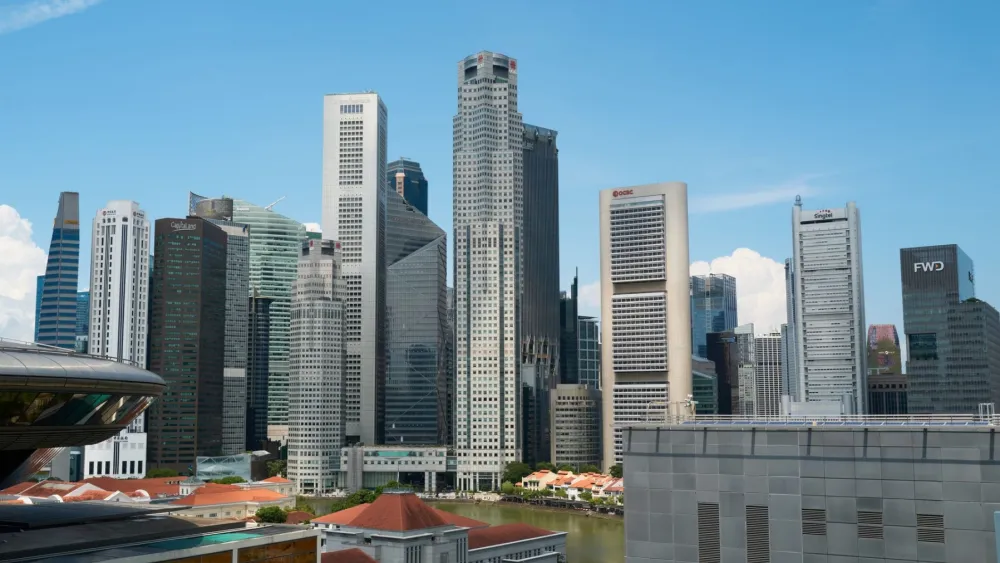
Will Singapore be caught in the US-China trade dogfight?
The STI fell 2.3% after Trump enforced tariffs on Chinese goods over intellectual property violations.
Following the news of US president Donald Trump’s US$50b-US$60b tariffs against Chinese goods over intellectual property violations, the MSCI Asia Pacific Index fell 3.3% and Singapore’s STI dropped 2.3% as of early Friday afternoon trading.
In an interview with Singapore Business Review, CMC Markets sales trader Oriano Lizza explained that the concern with the STI is that it isn't anti-fragile when it comes to a global upheaval. “Quite often, along with the rest of Asia, we will see the index and region hang on the coattails of the US economy and its performance,” he said.
“The performance is often reactive and somewhat lags the rest of the global economy as can be evidenced by this morning's trade session. Realistically, a 2% decline would reflect a major move in the STI and pertinent to this geopolitical play from President Trump is probably as bad as it's going to get,” Lizza added.
Global bourses are tense over fears of a trade war. Previously, Trump announced his intention to impose 25% tariffs on steel imports and 10% tariffs on aluminium imports. It has also been announced that the EU, Argentina, Australia, Brazil and Korea are now exempted from the steel and aluminium tariffs, a Morgan Stanley report revealed.
UOB reported that China’s Commerce Ministry said on Friday that while it does not hope for a trade war, the country is “not afraid of engaging in one”. Whilst the impact of the tariffs may be relatively small, “the concern will be whether this will spiral into an all-out trade war which clearly would be an overall negative for the US & the rest of the world,” said analyst Alvin Liew.
“For now, the unfolding trade tensions are not expected to have a significantly negative impact on global economic growth this year but the extent of the impact depends on any tit-for-tat
reactions from China,” Liew added.
Morgan Stanley estimates that around 50% of steel and aluminium imports are now still subject to tariffs. “This decision to exempt more countries has reduced the impact on trade partners and the risks of proportionate countermeasures from trade partners,” Morgan Stanley said.
Lizza noted that Singapore will generally be fairly safe initially from the tariffs as the US goes after larger global debtors such as China and Mexico. “The island state is in surplus to the states, but the major issue is whether or not Asia as a continent gets dragged into a slugging match with the US. China's response to the tariffs is key and as we can see it was relatively measured.”
Natixis Asia Pacific chief economist Alicia Garcia-Herrero concurred with Lizza that Singapore may be exempted from the tariffs. However, this is only the case “if it works hard with US on China isolation but it will still be very costly for Singapore as China is a major trading partner,” she said.
Worries can be rooted from the fact that Singapore’s trade-dependent economy will be negatively affected by the tension between the US and China. BMI Research senior analyst Chia Shuhui noted that exports could be negatively affected since they comprised 173% of the GDP in 2017.
In a report, JP Morgan analyst Benjamin Shatil noted that Singapore’s machinery and equipment exports exposure to the US at around 4% of GDP, taking into account indirect exposure through China. “The exposure is somewhat higher if other indirect supply-chain links are included. Against our base-line growth and inflation trajectories, trade protectionism is a lingering wildcard, potentially depressing activity through Singapore’s position in regional supply chains.”
Lizza concluded that trade relations between the US and China will be dependant on the global impact and whether or not Singapore is dragged into the dogfight. “I feel that unless required Singapore should take a back seat in the negotiations and not look to damage strong free trade agreements already in place,” he said.



















 Read Here
 Advertise
 Sign Up