
Singapore
HSBC Singapore revamps branch network
HSBC Singapore revamps branch network
This will include the revamp of its flagship Claymore branch.
9 in 10 graduates of Singapore's top universities hired within 6 months

The average gross monthly salary of those in full-time permanent employment rose to $3,733 from $3,613 in 2017.
CapitaLand to raise $1b for discretionary real estate debt fund

It will invest in USD-denominated instruments for real estate in China.
Little India commercial site launched for sale
The 25,865 sqft site was valued at $70.6m in 2018. A tender for a commercial site in Little India where a conserved two-storey bungalow, known as the former House of Tan Teng Niah, stands was launched for sale, according to an announcement by marketing agent JLL. Under the 2014 Master Plan, the leasehold 25,865 sqft site is predominantly zoned Commercial, with a section of the site to be retained as open space. Built in 1900, the former House of Tan Teng Niah is believed to be the last remaining Chinese villa in Little India, JLL said. Aside from the House of Tan Teng Niah, there are three other buildings located within the subject site. They include a pair of adjoining two-storey heritage shophouses at 41/43 Kerbau Road, a single-storey shop fronting Buffalo Road and a single-level retail building comprising 14 shops at 672 Chander Road with an open courtyard and two sheltered eating areas. The lettable space across all four buildings is almost fully leased. “As the shop lots and buildings are not strata-titled, the entire portfolio is to be sold in its entirety. We understand that the asset was valued at $70.6m late last year,” Karamjit Singh, senior consultant at JLL, said in a statement. The heritage site was reportedly built in 1900 and is one of the landmarks listed in the National Heritage Board’s Little India Heritage Trail. “To our knowledge, this could well be one of the largest plots of privately-held commercial land located in the vicinity of the Little India MRT station,” Singh added. Interested purchasers are invited to submit their offers before 2 April 2019 at 2:30 p.m.
Olam buys 85% stake in Indonesia's largest cocoa processor for $121.31m

The acquisition will add 150,000 metric tonnes of cocoa bean processing and capacity.
Golden Agri Resources lost US$1.77m in 2018
It blamed softer CPO prices and the losses from its joint venture.
Manufacturing output contracts for the first time since 2017
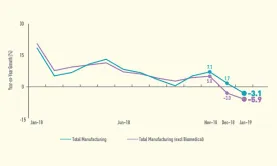
It shrank by 3.1% no thanks to declines in electronics and precision engineering.
Singapore loses out to Netherlands as world's most connected country: report

But the Lion City is expected to benefit from initiatives aiming to improve logistics and harmonise regulations. Singapore held its second position after the Netherlands for trade connectivity on the back of its policies that leverage on global connectedness, according to DHL’s latest Global Connectedness Index (GCI). The GCI report, which assessed the globalisation developments across 169 countries and territories since the Brexit referendum in the United Kingdom and the 2016 presidential election in the United States, found that Singapore was also one of the five countries where international flows exceeded expectations. The other countries included Cambodia, Malaysia, Mozambique and Vietnam.
Sheng Siong's FY2018 profits inched up 1.4% to $70.79m

The strong performance was attributed to its 10 new stores.
Daily Briefing: HRnetgroup to expand services in China; Shopee's weak performance hits Sea's earnings

And dining platform Chope forged partnership with China’s food delivery giant Meituan-Dianping.
Daily Markets Briefing: STI down 0.33%

Expect muted gains today.
Chart of the Day: Singapore's three big banks' NIMs rose to an average 1.8% in 2018
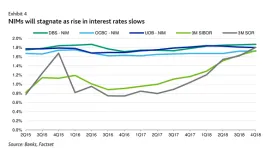
DBS outperformed OCBC and UOB with its NIM widening 9 basis points due to lower funding costs. This chart from Moody’s Investor Services showed that the NIMs for Singapore’s three big banks comprising of DBS, OCBC and UOB rose to an average 1.8% in 2018 from 1.75% in 2017. DBS outperformed the other two with its NIM widening 9 basis points because of lower funding costs, compared with 5 basis points for OCBC, and 1 basis point decline for UOB. NIMs are set to stagnate in 2019 because interest rates will not rise as steeply as they did in 2018, given worsening economic prospects, Moody’s said. “Interest rates in Singapore typically move in tandem with US interest rates, and the pace of further rate increases in the US will slow in 2019, with the Fed turning more cautions with monetary policy tightening and balance sheet reductions,” they explained, adding that stiff competition amongst banks for new mortgage financing and refinancing will deter banks from raising loan rates, which in turn will constrain NIM improvements. “Further, low-cost current account savings account (CASA) deposits at the three banks are decreasing as depositors gravitate to higher yielding fixed deposits to take advantage of rising rates,” Moody’s said. “This shift will lead to higher funding costs and weigh on NIMs.”
Singapore fintech investments rose two-fold to US$365m in 2018
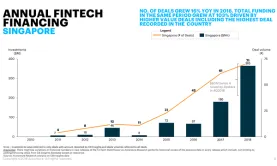
US$102.2m of the total funds raised went to lending fintech companies such as the homegrown Funding Societies.
MSIG Insurance pioneers video interaction pilot programme for motor claims
The new tool allows survey agents launch a video call on their web browser through a simple link.
St. Thomas Ville freehold en bloc site to be tendered at $58m
The 11,407 sqft site has an allowable height of up to 36 storeys.
Wilmar's FY2018 profits dropped 5.7% to US$1.13b

It blamed the African swine fever outbreak in China and weaker commodity prices.
Infant formula market dries up as mothers return to breastfeeding: report

Nine in 10 mothers in Singapore engaged in either partial or full breastfeeding in 2018.










 Read Here
 Advertise
 Sign Up
















Commentary
‘Tokenmaxxing’ – The wrong AI race to run in Singapore
To outsmart modern fraud, we must first know the enemy
Why Singapore SMEs cannot wait for quantum cyber risk to arrive before securing data
Is Singapore's emphasis on long-term security and stability hindering purpose-driven employees?
When Singapore's agentic AI ‘chefs’ arrive, will the kitchen be ready for them?
What Singapore’s app store rules reveal about the future of online trust
Faster hiring alone will not fix construction’s productivity problem
Beyond policy: How Singapore's service sector can win at the frontline
Solving the production problem behind Singapore’s ‘pilot purgatory’
Transformation without disruption: Your Existing ERP is an accelerant to business innovation