
Agentic AI exposes Singapore banking oversight gaps
Deloitte and Gartner warn autonomous AI systems are advancing faster than banking controls accountability and compliance oversight.
Singapore’s financial institutions are accelerating artificial intelligence deployment across fraud detection, payments, customer support, and software development, but governance controls are struggling to keep pace as AI systems move deeper into core banking operations.
According to Deloitte’s State of AI in the Enterprise survey, 64% of Singapore financial institutions already run AI in production environments, whilst around one-third have moved at least 40% of AI pilots into live operational workflows.
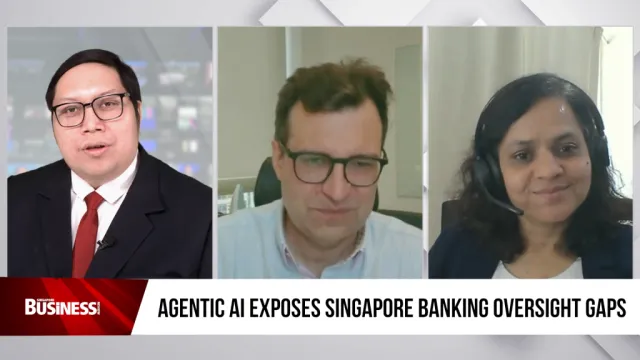
Chris Lewin, AI & Data Asia Pacific Leader and Executive Director at Deloitte, said banks and payment providers are adopting AI primarily to manage operational pressure and rising customer expectations.
He said AI is already improving transaction monitoring, customer service response times, operational efficiency, and fraud detection by helping institutions process information faster and identify unusual activity earlier.
The interview also highlighted growing concern around “agentic AI” systems capable of independently taking actions rather than simply generating recommendations or summaries.
Priyanka Shukla, Senior Principal Analyst at Gartner, warned these systems create a different category of operational and compliance risk because compromised AI agents could potentially move money, approve credit, or execute fraudulent transactions autonomously.
“With agentic AI, it's not just about AI giving advice or summarizing content,” Shukla said. “AI goes from giving advice to taking actions.”
She added that governance maturity across financial services remains uneven, particularly around accountability, third-party oversight, and visibility into AI systems embedded inside vendor platforms.
“The question is no longer whether AI's outcome is accurate,” Shukla said. “Now it is: was the agent authorized?”
The discussion also exposed a widening gap between AI ambition and operational readiness inside financial institutions.
Lewin said Deloitte research found 72% of Singapore leaders expect to deploy autonomous AI agents by 2027, but only 14% believe governance systems are mature enough to support them safely.
“The technology is moving fast, and the guardrails need to keep pace,” Lewin said.
Both executives argued AI governance is increasingly becoming a board-level issue rather than solely a technology function. They said banks now require cross-functional oversight involving compliance teams, risk leaders, business units, cybersecurity specialists, and executive management.
Shukla said institutions must build secure-by-design controls early rather than treating governance as an afterthought once AI systems are already operating inside payment systems, customer channels, and compliance processes.


























 Read Here
 Advertise
 Sign Up






Commentary
Is Singapore's emphasis on long-term security and stability hindering purpose-driven employees?
When Singapore's agentic AI ‘chefs’ arrive, will the kitchen be ready for them?
What Singapore’s app store rules reveal about the future of online trust
Faster hiring alone will not fix construction’s productivity problem
Beyond policy: How Singapore's service sector can win at the frontline
Solving the production problem behind Singapore’s ‘pilot purgatory’
Transformation without disruption: Your Existing ERP is an accelerant to business innovation
From Singapore to Southeast Asia: Thriving in innovation by knowing when to pause
Section 13O, MAS, and the digital footprint of Singapore Family Offices