SGD tests top of MAS band as RHB sees limited upside ahead
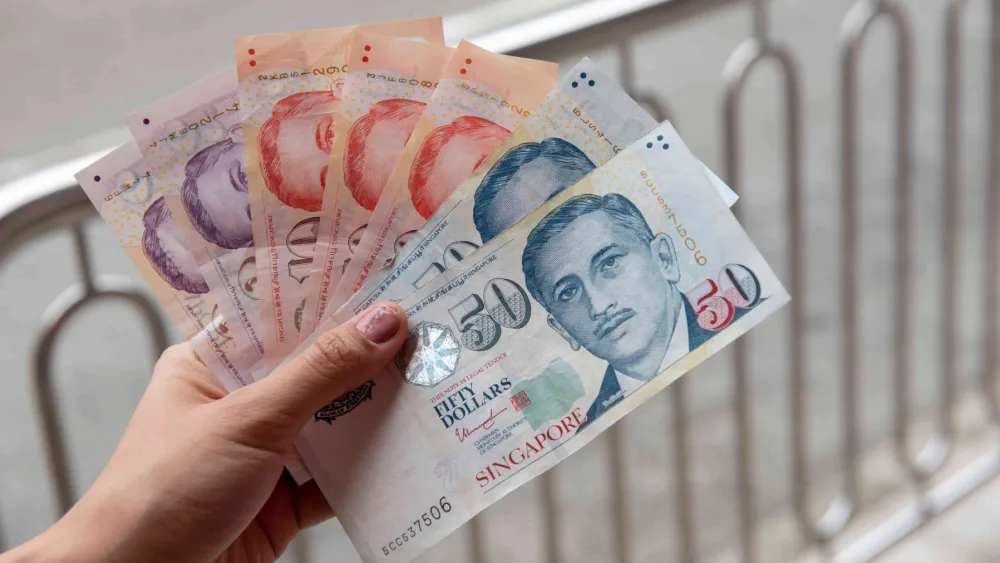
The Singapore dollar is the top-performing currency in ASEAN so far this year, appreciating 5.91% YtD.
The Singapore dollar is now testing the top of its policy band, signaling limited potential for further appreciation under current monetary settings, according to a new report from RHB.
“Our revised estimation suggests MAS S$NEER is already testing the top-bound band of 2.0% above its mid-point, suggesting that upside bias for further S$NEER appreciation is limited to the current perceived +0.5% annual appreciation gradient,” RHB analysts wrote.
The Monetary Authority of Singapore (MAS) manages the SGD through a basket, band, and crawl framework.
Whilst MAS does not disclose specific parameters, RHB’s model, based on 14 statistically selected currencies, achieves a 0.996 weekly correlation with MAS’s empirical S$NEER, with only ±0.08% deviation. This level of accuracy has given RHB confidence in assessing Singapore’s current monetary stance.
The Singapore dollar is the top-performing currency in ASEAN so far this year, appreciating 5.91% YtD, followed by the Thai baht (+4.77%) and the Malaysian ringgit (+4.57%).
“Equity fund inflows have persisted since year-to-date, recovering markedly since the decline during the US-China trade tensions in March–April, while bond flows are consolidating higher on the back of investors' confidence,” the report noted.
Despite this strength, economic warning signs are emerging. RHB forecasts a 2.4% contraction in Singapore’s Q2 GDP (QoQ, SA) and maintains a full-year GDP growth estimate of 2.0% for 2025.
The bank pointed to weakening performance in export-reliant sectors like manufacturing and wholesale trade and warned of heightened vulnerability to renewed global trade disruptions.
RHB expects MAS to keep its S$NEER policy band unchanged for 2025, maintaining the current slope and ±2.0% width. However, the firm cautioned that “we do not rule out the possibility of MAS flattening the slope or widening the bandwidth in a subsequent review should economic conditions worsen.”
Such adjustments may be considered if there is a re-escalation in US-China tariffs or a broader global slowdown, which could push MAS toward a more accommodative stance to support growth.
Looking ahead, RHB projected the USD/SGD to end 2025 between 1.330 and 1.340. However, risks remain balanced.
“The downside risks on SGD could come from the persisting trade-driven uncertainty and capital outflows,” RHB noted. On the upside, “a broader global slowdown... and the prolonged ‘sell America’ narrative” may sustain investor support for the Singapore dollar.
MAS’s next policy meeting in July 2025 will be closely watched as it weighs the growing trade-off between inflation containment and economic support.
























 Read Here
 Advertise
 Sign Up