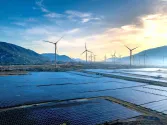
Singapore earmarks 300 hectares on Jurong island for green energy use
A key initiative is a planned cross-border carbon capture and storage (CCS) network being studied by S-Hub.
Singapore is positioning Jurong Island as a regional testbed for next-generation energy technologies, marking a significant pivot in its industrial strategy as the hub turns 25.
Around 300 hectares have been earmarked for new energy infrastructure, including solar, energy storage, and alternative fuels, as part of a broader shift towards decarbonisation and sustainable growth.
Among the pilot projects, a 118 MWp solar farm by Sembcorp is expected to generate enough electricity to power roughly 33,200 four-room flats annually.
A utility-scale energy storage system (ESS) with a capacity of 326 MWh is also under development, while firms such as Advario and VFlowTech are exploring advanced ESS solutions, including a proposed 40 MWh vanadium redox flow battery.
The transformation of Jurong Island is part of Singapore’s wider strategy to transition its energy and chemicals (E&C) sector towards low-carbon solutions.
The government is targeting growth in sustainable chemicals, circular feedstocks, and carbon capture technologies. According to JTC, which oversees the development of the island, Jurong Island’s sustainable-product output has grown 1.4 times since 2019 and is on track to meet its 2030 target of a 1.5× increase.
Refineries and crackers on the island now rank in the top half globally for energy efficiency, with an ambition to reach the top quartile.
A key initiative is a planned cross-border carbon capture and storage (CCS) network being studied by S-Hub, a joint venture between Shell and ExxonMobil. The project could deliver a storage capacity of at least 2.5 million tonnes of CO₂ annually, surpassing Singapore’s 2030 target of 2 million tonnes per year under the Sustainable Jurong Island plan.
Since 2021, 35 decarbonisation projects supported by the Resource Efficiency Grant for Energy have been approved, involving major players such as Evonik, ExxonMobil, Linde, and Air Liquide.
These are expected to reduce emissions by more than 340,000 tonnes of CO₂ per year—the equivalent of removing about 80,000 cars from the road. Chevron Oronite was recognised for strong performance in energy and greenhouse gas management.
Specialty chemicals and sustainable materials are another priority, with over 30 projects announced since 2021 by firms such as Arkema, Cariflex, and Kuraray. These are expected to create more than 1,000 jobs.
The sector is forecast to grow at 4% to 5% annually through 2030, outpacing the overall chemicals sector.
The island is also advancing low-carbon fuel and storage technologies. These include a bench-scale project for sustainable aviation fuel using hydrogen and captured CO₂—developed by IHI and A*STAR—as well as an ammonia fuel study for power and bunkering, led by Keppel with support from the Energy Market Authority and Maritime and Port Authority of Singapore.













 Read Here
 Advertise
 Sign Up