
Singapore
Experienced executives make up Singapore Airlines' new set of senior managers

Experienced executives make up Singapore Airlines' new set of senior managers
Singapore Airlines announced Thursday its new set of senior managers, all with years of experience as executives in SIA.
ST Kinetics inks US$20.9M arms contract with Brazilian Navy

Singapore Technologies Engineering Ltd. announced its land systems arm, ST Kinetics, has won a weapons contract worth US$20.9 million, or about S$29.4 million, from the Brazilian Navy.
CSC rakes in $224M revenue for first nine months of FY10

Geotechnical engineering specialist CSC Holdings has reported a net profit of $19.8 million on revenue of $224.0 million, for the nine months ending 31 December 2009.
DBS expands in China and India, cuts dependence on Singapore

In a bid to reduce reliance on its Singapore home market, DBS Group Holdings Ltd., Southeast Asia's biggest bank, is instead looking at expanding its operations in China and India without pursuing acquisition.
SingTel clinches Carling Cup

Singapore Telecommunications Limited (SingTel) announced Friday its mio TV has clinched exclusive broadcast rights to the 2009-2010 Carling Cup Final.
Singapore residential property weekend roundup: Centennia Suites Hot

Last weekend saw an uptrend in high end properties with hot interest in Centennia Suites, developed by The Lippo Group, along River Valley Road.
StarHub reports net profit of S$319.7m due to higher revenue

Decrease in taxation and lower interest expenses were cited as other factors contributing to StarHub's 2.7 percent year-on-year growth in net profit.
DBS posts S$2.06 billion net earnings for 2009

DBS outdoes itself by breaking records including growth in net interest income to S$4.46 billion and 17 percent rise in profit before allowances.
Singapore office market remains lukewarm in Q4 2009

CB Richard Ellis study showed prime office rents in Singapore fell despite increased activity of tenants.
Sembcorp Marine bares strategic shipyard expansion in Brazil

Sembcorp Marine revealed Thursday its wholly-owned subsidiary Jurong Shipyard (JSPL) will be building a new shipyard in Brazil to facilitate operations in one of the fastest growing offshore oil and gas exploration and production markets in the world.
Singapore Airlines to launch new cabin offerings

To provide additional space and comfort for its passengers, Singapore Airlines is set to launch new cabin products on some of its Boeing 777-200 aircraft starting late February.
Singapore posts strong recovery in real estate investments
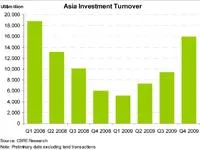
Singapore joined other Asian countries in witnessing property investment upsurge in the second half of 2009.
DBS inaugurates new headquarters building in Shanghai

Singapore's largest bank continues to grow its branch footprint in China with the inauguration of DBS Bank Tower located in Lujiazui.
How Banking should be more like water

The bottled water industry has figured out how to get to consumers and it’s through their hearts. Unlike banking which asks consumers to focus on the details of each product, bottled water successfully taps into the emotions of consumers by associating their product with the ideas of taste and style creating a consumer attitude towards bottled water based on their emotions and not logical comparisons of product features and benefits.
Tiger Airways celebrates feat with a promo

Airline offers 120,000 seats at zero cents after it reached its twelve millionth passenger.
Crust Gourmet Pizza Bars expands into SIngapore

Crust Gourmet Pizza Bars is looking into new markets not only in Australia but also oversees as it opens its 50th store.
Pan Pacific's Patrick Imbardelli talks branding

Patrick Imbardelli, CEO of Pan Pacific Hotels Group explains the group’s big year in 2009. How was the year 2009 for the Pan Pacific Hotels Group? 2009 was an important milestone year for the Group. Whilst several industry giants slowed down development with corporate cutbacks, we’ve had plenty going on. This year, we integrated both Pan Pacific and PARKROYAL brands under Pan Pacific Hotels Group, and with that, consolidated its corporate headquarters in Singapore from multiple prime business district locations into a centralised new location for more efficient use and deployment of resources.We build on our people capabilities by making important key hires into our team in the areas of strategy and planning, development, human resources, branding and communications. Part of the integration also included the launch of PANTHER Distribution System, a single distribution platform for both brands that provides customers with an improved reservation experience,while allowing the Group to streamline reservation operations across its two brands to achieve operational synergy and optimise revenue opportunities. We also reorganised our sales structure, integrating the sales teams for our Singapore hotels into a single Singapore Sales Team structure to manage client relationships and sales across the four hotels (PARKROYAL on Beach Road, PARKROYAL on Kitchener Road, Pan Pacific Orchard and Pan Pacific Singapore). With regards to our brands, we appointed global brand strategists Interbrand to conduct a brand review for our Pan Pacific and PARKROYAL brands to prime them for further growth. In line with our growth strategy to extend our brands’ footprints in Asia and North America, we also opened Pan Pacific Xiamen in August, and Pan Pacific Suzhou will be opening in January 2010. What were some of the key issues faced the hotel and tourism industry in 2009, in your perspective? What do you see happening? The slowdown in consumer demand has most certainly impacted multiple industries, including the hospitality industry. Winners and losers have emerged: the shortcomings and inefficiencies of properties that previously relied on good locations or healthy demand in the market have now come to light. At this time we saw more owners looking for alternative operators. The past year has also thrown up some important insight to ‘brands’. Consumers have certain expectations from brands that they are willing to pay more for. So as the trimmings have been “cost engineered” in these tough times, customers are saying, “I understand that I am paying less, so my expectations have adjusted. But I still want the core deliverables of the brand”. 2009 has in effect shifted consumer expectations and therefore it is important to learn what their constantly evolving drivers of needs are. This is vital for all brands but more particularly those in the hotel industry. I feel that learning this, and constantly making sure these consumer needs and expectations are not just met, but exceeded, will give rise to brand longevity which is what we ultimately need. How has PPHG dealt with this? We have taken steps this year to understand our customers better and use this insight to strengthen our brands. For example, our brand review with Interbrand will help us to ensure that our brands evolve with customer needs and expectations. Tactically, we launched several brand-wide campaigns that addressed guests’ current needs and expectations. We launched brand-wide tactical campaigns such as Pan Pacific Double Preferences which enhanced guest experience with perks like two complimentary amenities instead of one. We also used this time to chart our strategic expansion. In Asia, our growth plans include emphasis upon both brands while in North America, we are focused upon growing the Pan Pacific brand presence, as this is where we see the opportunity to perform given our customer base and strengths of the brand. For example, 2010 will see the opening of the Pan Pacific Suzhou, Pan Pacific Bangkok Serviced Suites and PARKROYAL Kuala Lumpur. How is this different from the other competitors in the market? Many industry players have reacted to the global downturn with cutbacks, but we have witnessed growth. At the same time, we have been able to do this because of our modest size, which allows us to act and react with flexibility, especially in a dynamic and challenging business environment. The quick integration of our sales teams, the launch of our brand-wide tactical campaigns; these are things a huge player may be able to do, certainly not as quickly or consistently, during a critical time when consumers were value. Our expansion plans are not focused upon rate of growth; we are not driven by simply adding properties for the sake of adding to the system. Our focus is upon growth that will make our system stronger in order to support properties managed by the Group. While we are gearing up for aggressive growth in our identified key markets, we are keeping to scale. For example, we can grow by 30-50 properties in the short to medium term, but we’re definitely not into adding, say, hundreds of hotels. With a limit to the number of owners, we can afford to spend time with each of them, which is not something that any of the big global brands can attempt. Our modest size and consequent shortened lines of communications has great significance to how we interact and work with our hotel owners. How do you think the industry has changed? What do you see players in the hotel industry doing about it? Many brands have chosen to turn their focus on their consumers, but many have also chosen to survive in this downturn through competing by lowering prices. As of now, what are PPHG’s priorities, in terms of markets and strategies? In Asia where our system is fairly well developed, we are looking for additional properties in key gateway cities and in certain countries, secondary and tertiary markets. In addition, we are focused on adding to our offerings in the resort segment as research shows us that this offers the Group huge potential given its consumer base and strengths of the brands. The Asian gateway cities in which we are extremely proactive include: Shanghai, Beijing, Tokyo, Osaka, Hong Kong, Sydney and Melbourne. We continue to see substantial investor interest in China despite the downturn. We hope to establish a presence in Beijing and Shanghai, and emerging cities like Chengdu, Shaoxing, Guangzhou and Dalian. In North America, we also are focused upon first securing management contracts in key gateway markets; first tier of importance are New York, Chicago, LA, and San Francisco. Following these are other major markets such as Boston, Toronto, Washington DC and resort markets such as those in Hawaii, Florida, and California that would benefit from what our system can deliver. In 2009, while many industries are suffering, PPHG is still growing and expanding. Why do you think this is so? We feel the groundwork we have done this year has put us in a position where we are in a good position for an upturn. The integration of our two brands and our strategic expansion plans lent to establishing Pan Pacific Hotels Group brand as an international hotel management company.







 Read Here
 Advertise
 Sign Up











Commentary
What Singapore’s app store rules reveal about the future of online trust
Faster hiring alone will not fix construction’s productivity problem
Beyond policy: How Singapore's service sector can win at the frontline
Solving the production problem behind Singapore’s ‘pilot purgatory’
Transformation without disruption: Your Existing ERP is an accelerant to business innovation
From Singapore to Southeast Asia: Thriving in innovation by knowing when to pause
Section 13O, MAS, and the digital footprint of Singapore Family Offices
Could Singapore lead the world's next management revolution?