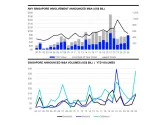
Singapore market most stable in Asia
The country's earnings volatility is the lowest in the region, having stayed at 21.4% in the last 5 years.
And this is well below the regional average of 25.7%, according to HSBC’s report.
Here’s more from HSBC:
| Sectors and stocks Singapore is a stable developed market. It traditionally trades at a premium to the rest of the region. It is concentrated, with financials dominating. This makes sector selection important. Market structure MSCI Singapore is concentrated, with financials constituting 46% of the index. The second biggest sector is industrials 24% followed by telecoms 12%. Most of these companies, however, have a distinct non-Singapore flavour to them. For example, SingTel owns assets in India and Indonesia, most industrials export equipment to oil producers in the Middle East or build ships for global buyers, while various financials have expanded across Asia (DBS) or ASEAN (UOB). Indeed, five out of the 10 MSCI sectors are not present in MSCI Singapore. The top-5 and top-10 stocks constitute 48% and 66% of the index, respectively. After the ASEAN markets, it is the most concentrated market in the region. Despite this concentration on financials, Singapore does offer a number of well-regarded companies in sectors such as real estate, shipping, and telecoms. Some of these have global leadership in various niche products (think oil rigs). Singapore is classified as a developed market by MSCI. It is a liquid market with daily market cap about 30x cumulative monthly trading volumes. Earnings Singapore earnings are currently trading near trend. Austerity measures to cool the real estate sector might be one reason for the drop in earnings momentum in 1H11. Singapore earnings are the most stable in the region. This is supported by the fact that earnings volatility in the last five years has been 21.4%, well below the regional average of 25.7%. Indeed, on a five-year historical basis, this is the least volatile market in Asia. For example, during the downturn of 2008 Asia ex Japan EPS growth fell 27.8%, while Singapore’s EPS registered negative growth of 12.7% . As Singapore companies’ earnings are more dependent on external factors, analysts often turned positive on earnings when there were signs of the trade cycle improving. These global trade flows are expected to improve in 2H11 as inventories have fallen and Japanese companies are back to full speed following the March tsunami.
|
























 Read Here
 Advertise
 Sign Up