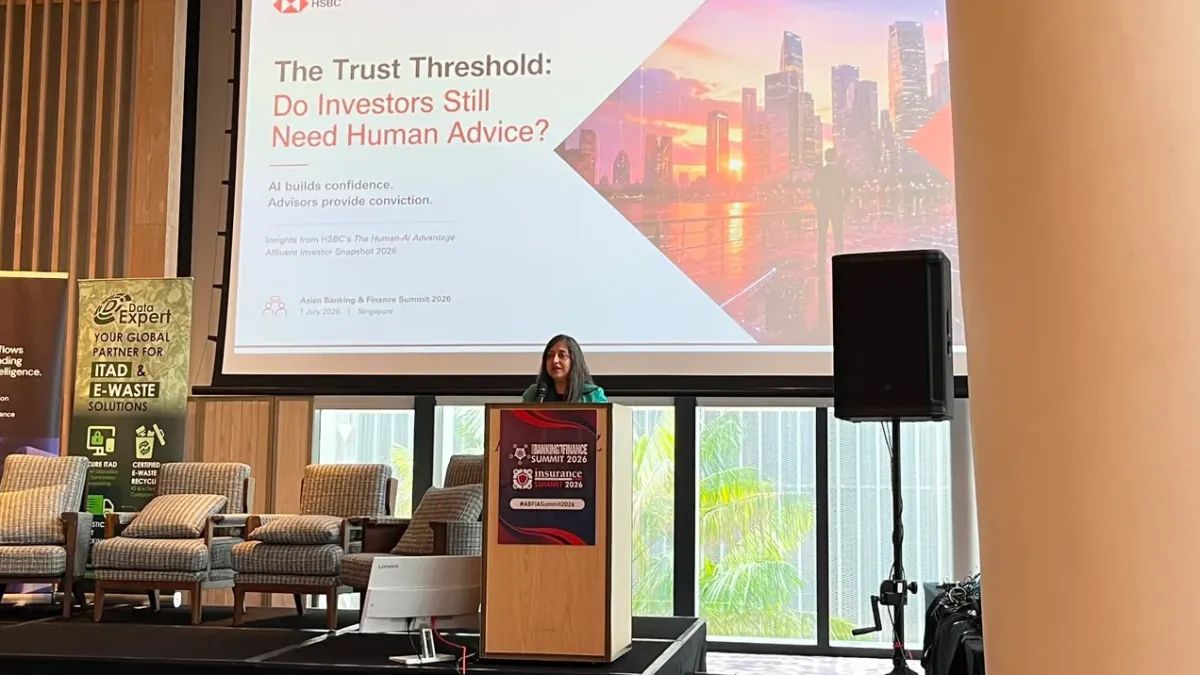
Nine in 10 investors do not trust AI for investment decisions
Banks can respond by moving toward a hybrid advisory model.
Investors across Asia are turning to artificial intelligence (AI) for research and analysis, but just 8% use it to make major investment decisions.
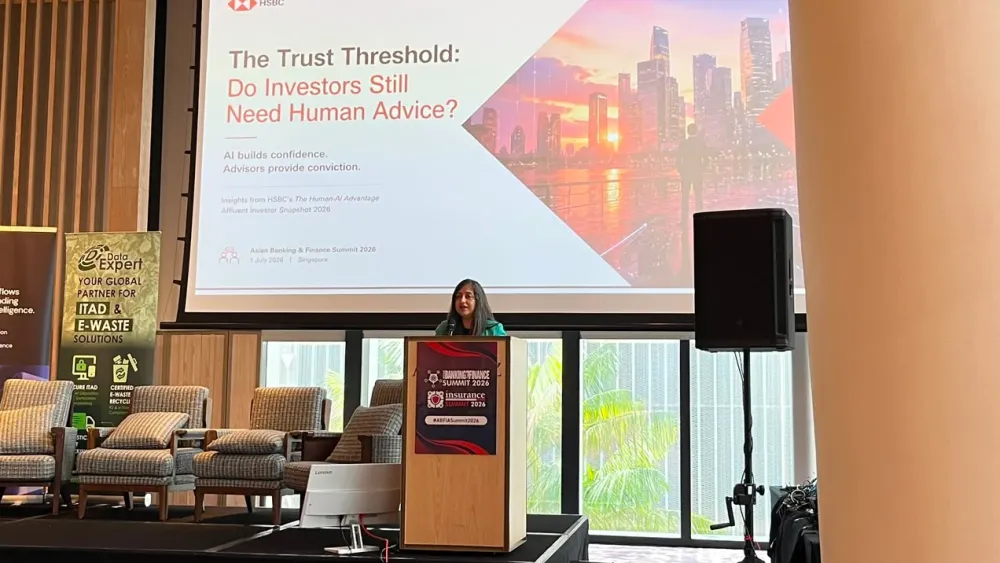
Speaking at the Asian Banking & Finance and Insurance Asia Summit in Singapore, Ashmita Acharya, head of international wealth and premier banking, HSBC Singapore, said that 73% of investors globally use AI for financial and investment tasks.
"There's a big difference between consuming AI for information research and getting a second opinion, but that’s not the case right now when it comes to decision-making,” Acharya said.
She noted that the gap holds even in Singapore, as 76% of Singapore investors use AI for financial and investment tasks. Furthermore, only 12% said AI was the most influential factor in their actual decision-making.
"Singaporean customers, in their own way, are very astute; they're very literate, so they're able to consume a lot of AI information. For wealth advisory, this means that information is no longer the differentiator. Interpretation is.”
Acharya said 62% of investors cited financial professionals and institutions as the source of their last investment decision, with 37% naming institutions as the single most influential factor in their decision-making overall.
The reluctance to hand decisions to AI, she said, comes down to trust and reassurance.
"AI, right now, is still not perfect," Acharya said. "We need to challenge assumptions, contextualise insights and give clients confidence. Trust is where humans make the difference.”
She added that the trend cuts across age groups, not just younger investors. Both Gen X and Baby Boomer adoption of AI for investment tasks stood at 72% in Singapore, both above the global average of 65% and 59% respectively.
Looking ahead, the majority of investors in Singapore (58%) indicated a preference for a hybrid approach to financial tasks, with AI and advisors working together. This preference is on par with the global average (57%) and spans across all generations.
“The future of wealth isn’t AI versus humans. It’s AI and humans working together,” Acharya said, adding that banks can respond by moving toward a hybrid advisory model — using AI to automate research and preparation work, whilst freeing up advisors to focus on judgment-driven, client-facing conversations.
But better-informed clients expect a different kind of advisor, she noted. “72% still look for strategic expertise,” with advisors adding value by applying judgment, validating client decisions, and catching errors that AI tools may still miss.
"AI is here to stay. Human judgement is here to stay too. The future belongs to those who bring the two together,” Acharya said. “The opportunity isn’t to replace the advisor. It’s to redefine the wealth advisory conversation.”




















 Read Here
 Advertise
 Sign Up