Seatrium starts exporting power from floating LNG-battery lab
Surplus electricity from the platform can support around 1,500 four-room HDB households.
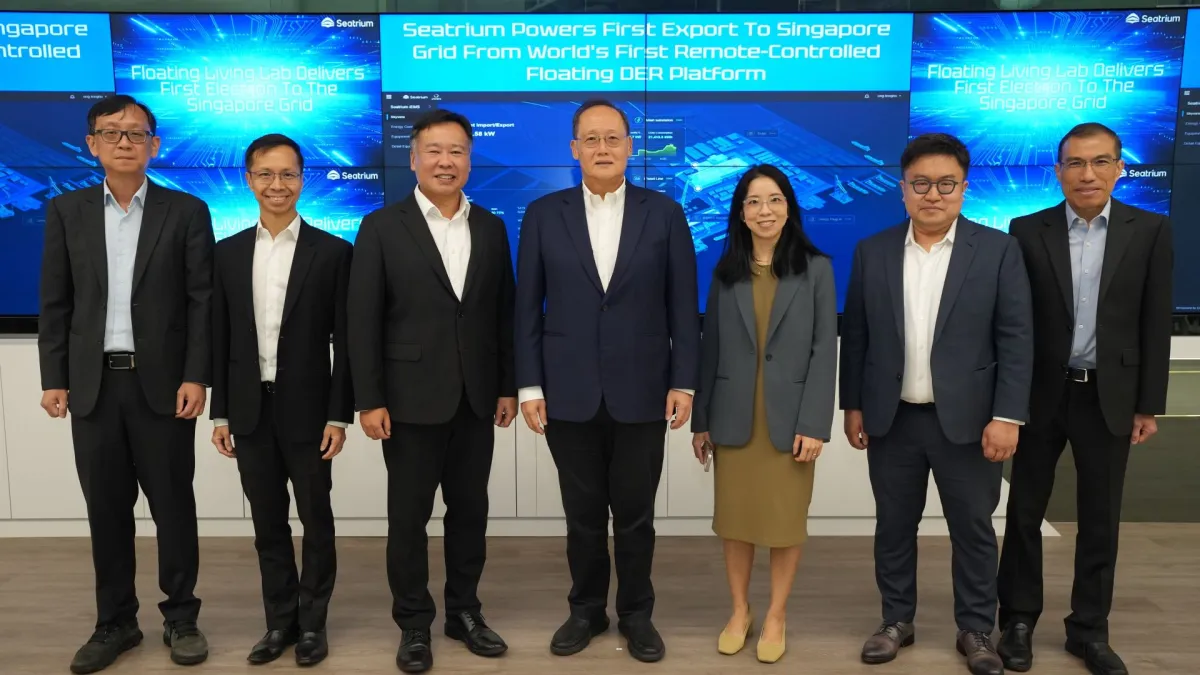
Seatrium has started exporting electricity from its Floating Living Lab (FLL) to the Singapore power grid, using a floating platform that combines liquefied natural gas (LNG) generation with battery energy storage.
The company said the platform generates electricity for its own operations before exporting excess power to the grid where it estimates that the surplus electricity is enough to support around 1,500 four-room HDB households.
The platform received its first LNG cargo through ship-to-ship bunkering in March.
The project was witnessed by Tan See Leng, Singapore's minister for manpower and minister-in-charge of energy and science and technology.
The Floating Living Lab is designed as a distributed energy resource (DER) platform that can supply electricity to both offshore operations and the national grid.
The facility has also received the Remote-CON notation from the American Bureau of Shipping (ABS), allowing key onboard systems to be monitored and controlled from an onshore operations centre.
ABS senior vice president and chief technology officer Patrick Ryan said the project demonstrates the implementation of remote-control capability under the classification society's standards.
"Safety is fundamental to the successful deployment of new remote-control and distributed energy technologies in offshore and nearshore environments," Ryan said.
Seatrium also operates an onshore Remote Operations Centre built on assurance frameworks developed by DNV. According to the company, the centre uses artificial intelligence (AI) to automate data processing, monitor energy systems, and support operational decisions.
It also incorporates cybersecurity measures, including post-quantum encryption.
Lee Wey Lii, senior vice president of Seatrium Digital, said the first electricity export validates the platform's ability to supply both Seatrium's operations and the national grid.
"The first electron transfer marks a key milestone, validating the FLL as a grid-integrated asset that contributes to national energy resilience while powering our internal demands," Lee said.
The project was developed with support from the Energy Market Authority (EMA), which supported the deployment of the battery energy storage system.
EMA director for solar and grid solutions Violet Chen said the FLL provides an environment for testing new energy technologies under operational conditions.
"As Singapore's grid incorporates more variable renewable energy, storage solutions like this will be important to maintain grid stability and resilience," Chen said.
Seatrium said it intends to apply the platform's capabilities to future floating energy storage and nearshore electrification projects.























 Read Here
 Advertise
 Sign Up