Office rents may dip 10-15% in 2012
The annual growth rate for 2011 was 13% which is a sharp contraction from 2010's recorded growth rate of 24.5%.
According to the combined research of CoreNet Global in conjunction with CBRE and Colliers International,, regional growth in the office leasing market is likely to remain sluggish throughout 2012 given the unresolved European debt crisis, the grim state of the American economy, and the slowdown in China's growth which is continuing to negatively impact occupier sentiment in the Asia Pacific.
The group reports that demand for office space is expected to continue to weaken in virtually all markets across Asia as corporate occupiers, particularly those in the banking and finance sector, seek to cautiously monitor costs and reduce spending. Many investment banks have already reduced headcount across their business lines and further downsizing is expected in the coming months.
Outside of the banking and finance industries, corporate occupiers may be less sensitive to volatility in the short term and could still exhibit steady demand. Nevertheless, for many markets this will not be enough to fill the sizeable gap created by the lack of activity by financial institutions. One bright spot, however, could be in decentralized districts which may see positive rental growth as tenants explore more cost effective options in non-core locations.
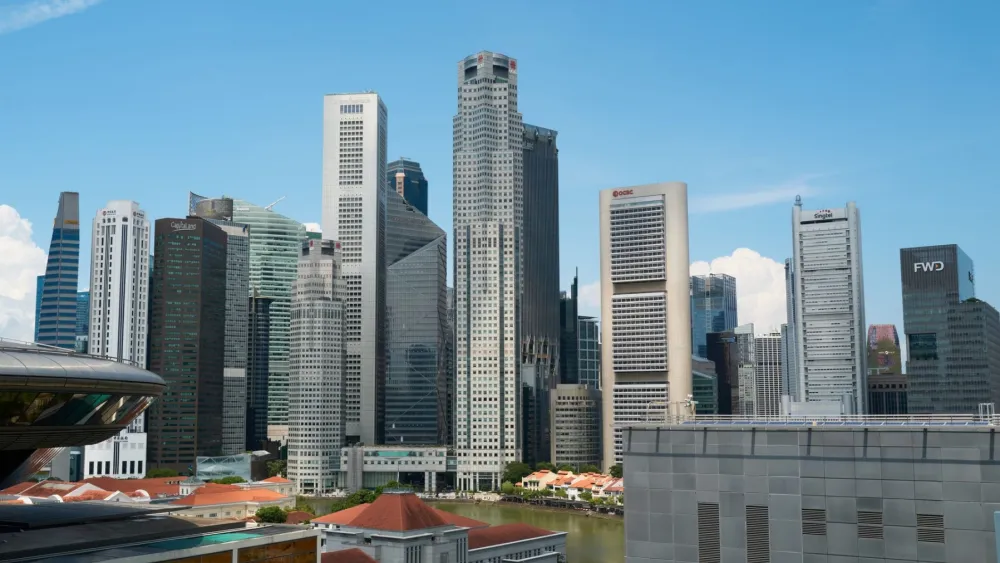
With regards to Singapore, Mr. Taam remarks that the office leasing market has also succumbed to the stress of recent economic uncertainties and volatilities. "Its impact is illustrated by the annual growth rates for the office leasing market locally. The annual growth rate for 2011 was 13% which is a sharp contraction from 2010's recorded growth rate of 24.5%."
For 2012, he points out that Singapore's office rents are expected to undergo a further correction but any decline is likely to be mild compared to the downturn witnessed in 2009 following the global financial crisis. "Office rents for Singapore are forecast to decline by around 10-15% in 2012. This is in contrast to the 20-50% correction seen in the first year of the global financial crisis in 2009."
On a more positive note Mr. Taam expresses, "Whilst moderating demand is likely to impact on Singapore rents in the short term, the city remains a key international business hub within the region. As the global economy gradually recovers, increasing business focus on the rapidly growing Asia Pacific region will mean Singapore is likely to see a return to healthy demand conditions in the coming years."
Looking ahead, Mr. Taam states that caution seems to sum up the overall market sentiment. "Consequently, we expect leasing demand to weaken moderately during 2012 due mainly to slower economic growth and a reduction in corporate hiring. Any leasing activity is therefore likely to be dominated by relocation and decentralization."
Commenting on the outlook for the sector in Asia, CoreNet Global's Regional Chair Mr. William Taam states that corporate occupiers will generally remain cautious in 2012, whilst continuing to look for more cost effective options. "Expectations for 2012 have been downgraded from rent growth to rent stabilization or even a downward adjustment for most markets in Asia."
Looking at the region as a whole, Mr. Taam confirms that Hong Kong currently tops the list as having the most expensive office space in the Asia Pacific with an annual occupancy cost of US$244 per square foot. It is closely followed by Tokyo in second place at US$197 per square foot, with Beijing ranking third at US$130 per square feet.
























 Read Here
 Advertise
 Sign Up