LIST: Top 20 SG stocks with highest net institutional inflows in Q2
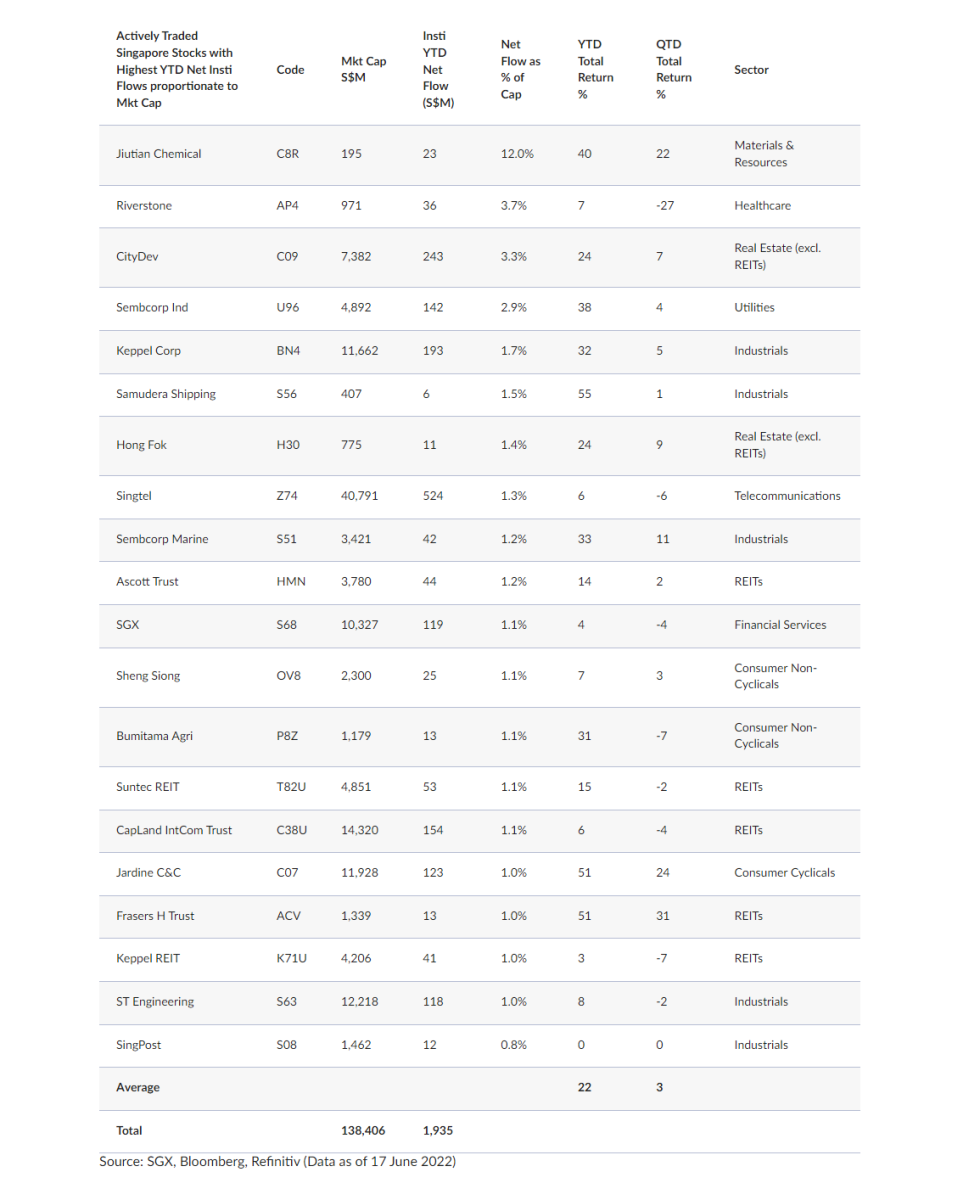
In total, the 20 booked $1.94 billion of net institutional inflows in the year-to-date.
Singapore Telecommunications (Singtel) led the list of top 20 Singapore stocks which booked the highest net institutional inflows in Q222, booking $524m, data from the Singapore Exchange (SGX) showed.
Joining Singtel in the top 5 were City Developments Limited with $243m, Keppel Corporation with $193m, CapitaLand Integrated Commercial Trust (CICT) with $154m, and SembCorp Industries Limited with $142m.
In total, the 20 booked $1.94 billion of net institutional inflows in the year-to-date and averaged a 22% total return in the 2022 YTD.
When looking at companies with the highest net institutional inflows proportionate to their current market capitalisation, however, Singtel was bumped off from the top by Jiutian Chemical Group.
SGX said Jiutian Chemical Group booked $23m of net institutional inflow in the year-to-date which represents 12.0% of its current market capitalisation.
Looking at the overall Singapore stock market, the 2022 year-to-date net institutional inflow was S$74 million.
Amongst stocks, SGX said the technology sector was the weakest, whilst hospitality and real estate also lagged in Q2.


























 Read Here
 Advertise
 Sign Up