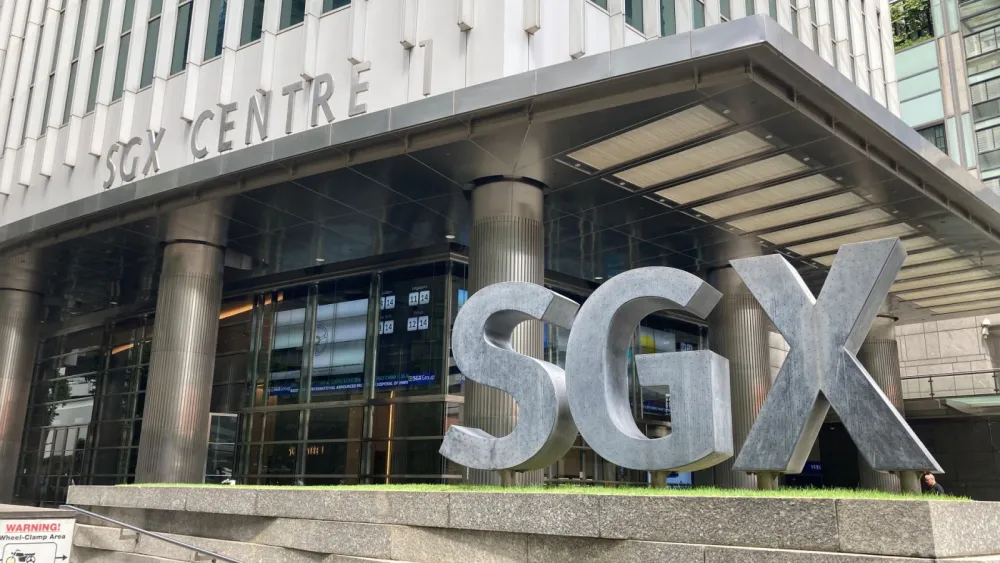
Stock market booked net institutional outflows of $2.66b in H1
The net institutional outflows were led by Financial Services and REITs.
The Singapore stock market also booked net retail inflows of $1.48b in the first half (H1) of 2023, with market makers and active traders making up the difference, said SGX.
Sembcorp Industries led the 100 stocks with the highest net institutional inflows.
Also, during the said period, the Straits Times Index (STI) went down 1.4% in price to 3,205.91, with “reinvested dividends boosting the total return of Singapore’s benchmark to 1.2%.”
For the second quarter of 2023, the STI generated a 5.58% trading range from high-to-low, which was marginally lower than the 5.60% trading range from high-to-low in the third quarter last year. This makes it the lowest percentage trading range since the STI’s 5.05% high-to-low range in the third quarter of 2017.
Outlier performances within the Singapore stock market, saw the average total return of the 100 most traded stocks in 1H23 at 3.2% versus the median total return of 0.5%.
Meanwhile, stocks that joined the 100 most traded stocks in 1H23, from ranking outside the 100 most traded in 2022, included Medtecs International Corporation, Tianjin Pharmaceutical Da Ren Tang Group, Delfi, Food Empire Holdings, Thomson Medical Group, PropNex, China Aviation Oil (Singapore) Corporation, Great Eastern Holdings, Sabana Industrial REIT and Cosco Shipping International (Singapore) Co.
























 Read Here
 Advertise
 Sign Up