Fintech investments at three-year low; generative AI at 'early growth' stage
Consolidation drove fintech investments in the payments space, KPMG found.
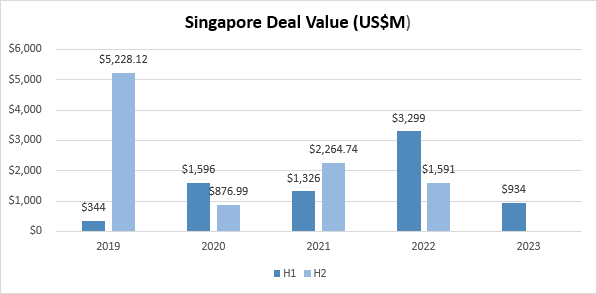
Singapore fintechs raised only US$934m across 94 deals in the first six months of 2023, 41% lower from the US$1.6b of funding the sector amassed in H2 2022, according to latest data from KPMG.
This followed global trends, where fintechs as a whole clinched US$63.2b in investments across 2,153 deals in H1. This is lower by over $10b from the US$63.2b of investments gained by 2,885 deals in H2 2022.
For Singapore, the first-half investment is a three-year low, although it was still well above the H1 2019 slump of just US$344m across 70 deals.
“The cloud of uncertainty permeating the global market continued to wear on investors, driven by factors including global macroeconomic concerns–high inflation and rising interest rates– [as well as] geopolitical tensions, and tech sector challenges–depressed valuations and a continued lack of exits,” KPMG wrote in its latest Pulse of Fintech report.
AI and ML attract investments
Artificial intelligence and machine learning fintechs in the Lion City notably captured US$129m in investments across six deals. This signifies an early growth of application in generative AI particularly in the areas of cybersecurity, insurtech, and wealthtech, KPMG noted.
“It is still very early days when it comes to the application of generative AI to use cases in financial services,” said Anton Ruddenklau, Global Fintech Leader at KPMG.
Looking forward, however, Ruddenklau said that it is an area that is attracting enormous interest and funding—particularly in areas like cybersecurity, regtech, and wealthtech.
“Over the next six months, we’ll start to see an uptick in investors embracing the space as corporates demand ways to leverage generative AI effectively,” he noted.
Payments, crypto still popular bets
Payments remained one of the top funded sectors, attracting a total of US$119.6m across 8 deals. In the payment space, Singapore-based Thunes raised the largest round in the ASPAC region, amounting to US$60m.
Consolidation was a key factor driving funding activity in the payment space. During H1, a number of fintechs embraced acquisitions in order to scale and grow their reach. During 2021 and much of 2022, global investors in the payments space embraced a broad range of payments solutions and opportunities — with Buy Now Pay Later (BNPL) companies accounting for many of the largest deals.
In 2023, this focus shifted significantly, with many investors shifting their attention back to fintechs with core payments processing capabilities and robust business models.
Crypto also remains a hot spot, with US$234.7m in investments across 36 deals.
“Within the crypto space globally, Singapore has gained prominence among investors and startups as a strong forerunner. This comes as the nation has in place regulations such as the Payment Services Act and Digital Token Payment Act and is in the process of issuing regulations related to stablecoin issuance,” Ruddenklau said.
“It wasn’t a surprise to see fintech funding decline in the first six months of 2023, given the enormous headwinds pressuring the market at the moment,” said Judd Caplain, global head of financial services at KPMG."
But the long-term business case for many subsectors within fintech remains very strong—particularly for sectors like payments, insurtech, and wealthtech. Once market conditions begin to even out, funding will likely rebound--if not to the record level experienced in 2021," Caplain said.



























 Read Here
 Advertise
 Sign Up