MBA students chase practical experience
Singapore MBA students prioritise real-world skills and career outcomes
MBA applicants in Singapore are increasingly prioritising practical experience and career outcomes as employers shift focus from narrow specialists to leaders who can operate across functions.
Enrolment across eight MBA providers in 2025 inched up 0.05% to 3,878 students from a year earlier, according to the latest survey by Singapore Business Review. Schools said students are becoming more selective, focusing on whether a programme can translate into faster career progression and measurable returns.
INSEAD Business School enrolled the largest group, with 976 students in its single MBA programme, followed by PSB Academy with 830 students across four programmes.
Amity Global Institute had 655 students across two programmes, Kaplan Higher Education Academy 391 across four, James Cook University Singapore 307 in one, SP Jain School of Global Management 301 across two, TMC Academy 245 across four, and Singapore Management University 173 in its single MBA offering.
Business schools said applicants are paying closer attention to how programmes align with employer demand, particularly as companies seek managers who can handle technological disruption and evolving business models.
Rashmi Udaykumar, CEO and head of the Singapore campus of SP Jain, said programmes offering strong industry exposure and analytics training are gaining interest.
“Applicants are more outcome-focused, more career progression-focused and seek faster career acceleration,” she told Singapore Business Review via Zoom.
Dr Susie Khoo, nonexecutive chairwoman at Kaplan, said prospective students are evaluating whether an MBA would produce tangible returns.
“The evaluation criteria for what constitutes a good MBA have sharpened significantly,” she said in a separate Zoom interview. “If I spend this much, will it give me a return on investment?”
Applicants are also interested in emerging fields such as artificial intelligence, sustainability, innovation, digital transformation, and business analytics, Khoo said.
Mark Stabile, dean of degree programmes and professor of economics at INSEAD, said students want programmes that prepare them to lead organisations facing rapid technological change.
They want leaders who can operate across borders, exercise sound judgement under uncertainty, and engage with the opportunities and risks presented by AI and fast-moving technologies, he said in an emailed reply to questions.
Economic conditions are shaping student priorities. Singapore’s economy grew 5% in 2025, easing from 5.3% in 2024 but exceeding the Ministry of Trade and Industry’s 4% forecast.
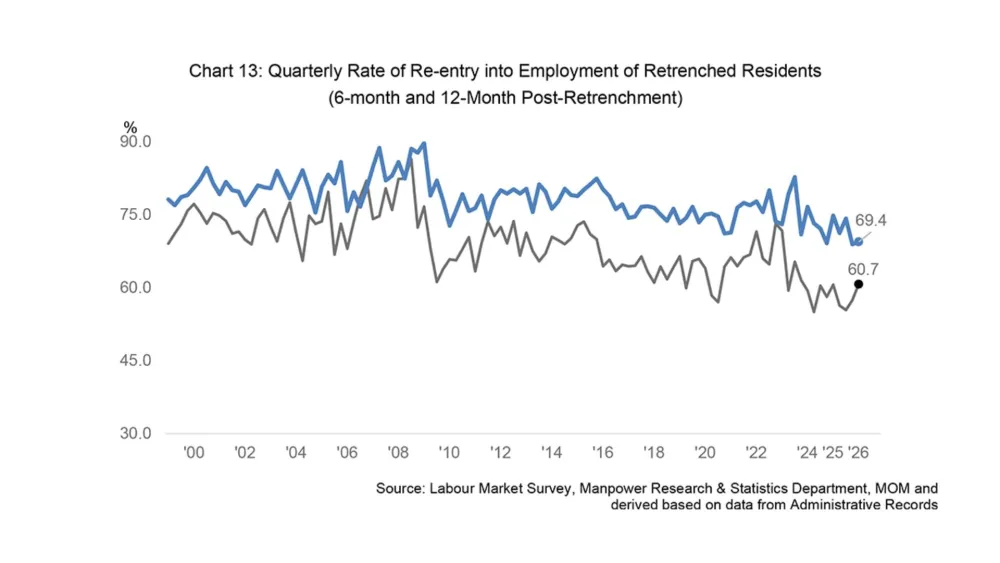
The labour market remained stable, although retrenchments rose to 14,400 from 13,020, largely in transportation, storage, and financial services.
“The job market is very dynamic,” Khoo said. “Expectations keep evolving,” she added, noting that this creates a gap between what employers want and what employees think they want.”
Employers are increasingly seeking leaders who understand AI, data analytics, and digital tools, even if they are not technical specialists.
Schools said companies want managers who can integrate these technologies into strategy, finance, and operations, adjusting to automation and digital transformation. Cross-functional skills and the ability to handle complexity have become key indicators of leadership potential.
Singapore’s policy environment reinforces the trend. Stabile noted that government investment in AI has fostered a culture where continuous professional development is both expected and supported.
In January, Josephine Teo, minister for Digital Development and Information, announced more than $1b in funding through 2030 under the National AI Research and Development Plan to strengthen Singapore’s research ecosystem.
Business schools are responding with expanded programmes and flexible formats.
INSEAD and SP Jain emphasise studying across global campuses to build adaptability, cross-border competence, and industry exposure.
INSEAD has also unveiled its Master in Finance, a course for senior executives, and a three-day programme on AI, disruption strategy, and leadership development.
Kaplan is increasing flexible learning arrangements and integrating industry practitioners into classroom instruction.
Udaykumar said demand for agility and a global mindset would remain central to MBA education.
“The MBA of the future will be skill-integrated, experiential, technology-enabled,” she said. “It will be more immersive or experiential, it will be technology-enabled.”
Success comes from combining academic rigour with measurable career impact, she said.
In the near term, Khoo expects demand to remain stable, although MBA programmes face growing competition from specialised master’s degrees in fields such as data analytics, digital transformation, and emerging technologies.






















 Read Here
 Advertise
 Sign Up