Fujitsu Asia Pte Ltd scores win at Singapore Business Review International Business Awards 2026
The company was lauded for powering faster and more efficient AI research at one of the leading technical universities in Singapore.
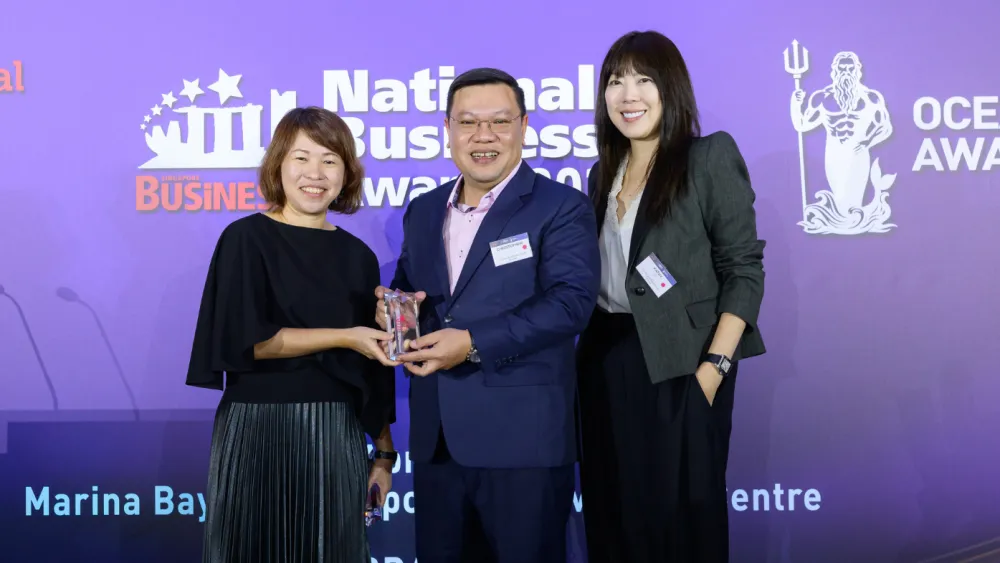
Fujitsu Asia Pte Ltd emerged as the recipient of the Technology accolade at the Singapore Business Review International Business Awards 2026. The award honours the company’s recently introduced AI Computing Broker (ACB) services, a workload broker technology that effectively utilises the available GPUs for AI workloads together with it’s on-going trials in a proof-of-concept project with a leading university in Singapore.
The technology delivers a smarter, efficient, and more sustainable way for students and researchers to develop and test their artificial intelligence models in limited available GPU environment by efficiently orchestrating their workloads between CPUs and GPUs to ensure only their intended tasks are executed.
As AI adoption accelerates globally, many organisations face the common challenge of limited GPU availability, rising compute costs, and complex infrastructure. Traditional systems often leave valuable GPU capacity underutilised using in-efficient scheduler’s memory partitioning techniques, owing to more idle GPU times, causing researchers to wait in long queues for GPUs to be allocated according to their load requirements or spend time in architectural overheads like managing containers instead of building models directly following bare metal approaches.
To respond to these challenges, Fujitsu’s ACB acts as runtime-aware middleware and orchestrates GPU resources in real time. This approach uses time sharing approach rather than a memory partitioning approach, ensuring every available compute cycle is used effectively. Unlike conventional approaches, ACB shares GPUs across multiple workloads without rigid partitioning or heavy container overhead.
Additionally, it supports bare-metal approach, custom container support, eliminating the mandatory need for containerised approaches like Kubernetes, which allows developers/researchers to submit jobs directly and immediately begin experimentation. The leading university’s researchers, many of whom are academic background, previously relied on Kubernetes-based schedulers that required container setup before workloads could be run. This caused researchers to focus a bit on the container setup, allocating resources, managing it which is actually an additional workload. With ACB, students gain on-demand access to GPU resources and submit jobs directly without the need to manage containers.
The benefits of ACB extend to both operational and financial aspects. Roughly in Fujitsu’s own experiments, it shows an estimated reclaim of 25% of idle GPU capacity, which when not effectively utilised, will actually be a hidden “idle tax,” thereby converting existing infrastructure into higher-value performance. Organisations can achieve faster model fine-tuning, inferencing and shorter iteration cycles without investing in additional GPUs.
Moreover, ACB supports sustainability goals by reducing unnecessary energy consumption. Higher utilisation means fewer idle systems drawing power. This helps mitigate heat generation and lowers the overall environmental impact of AI workloads—a critical differentiator amidst increasing energy costs and constrained GPU supply.
Designed to grow alongside evolving AI demands, ACB complements by integrating with existing environments such as SLURM and supports distributed, multi-node workloads. It has a flexible architecture that enables seamless scaling from early-stage experimentation to large-scale model executions.
Fujitsu’s ACB roadmap clearly shows that it's aiming to incorporate support for Kubernetes environments, MIG-enabled GPUs, Triton Inference Server, and broader interoperability across AI ecosystems. Further, Fujitsu plans to build a hybrid computing platform with these workload broker technologies currently in place to support calls between CPUs and GPUs, further extending to support calls to Quantum computing architecture under this platform.
The proof-of-concept with the leading university aims to achieve how ACB can help in removing infrastructure barriers and unlocks the full potential of limited GPU resources. This technology will empower institutions and enterprises to accelerate AI development and innovate continuously.
As Fujitsu continuously refines the solution in collaboration with the leading university in Singapore and other customers globally, ACB is emerging as a replicable model for organisations worldwide seeking to scale AI responsibly and sustainably.
The Singapore Business Review International Business Awards is a prestigious programme that celebrates the outstanding achievements of foreign companies in Singapore. The awards recognise transformative business initiatives, innovative strategies, and impactful projects that have enabled these companies to establish a robust presence in the competitive landscape of the Lion City.
The Singapore Business Review International Business Awards is presented by Singapore Business Review Magazine. To view the full list of winners, click here. If you want to join the 2027 awards programme and be acclaimed for your company's outstanding contributions in Singapore's vibrant business landscape, please contact Danica Avila at [email protected].

























 Read Here
 Advertise
 Sign Up