Tech funding surges 2,116% in June as late-stage deals dominate
Early-stage share collapsed from 40.9% to 8.9% year-on-year.
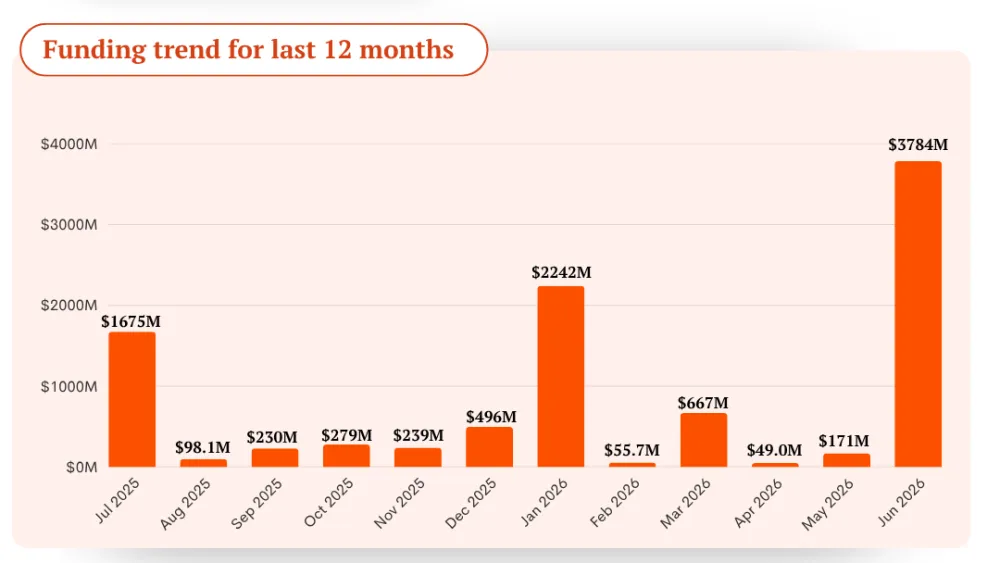
Singapore's tech equity funding reaching $3.78b in June, surging 2,116% month-on-month (MoM) and 1,754% year-on-year.
Late-stage funding dominated Singapore’s tech funding in June 2026, accounting for 87.7% of total funding activity, according to Tracxn.
Early-stage funding represented 8.9% of deals, whilst seed-stage funding accounted for 3.3%.
Compared with June 2025, late-stage funding’s share increased 38.7 percentage points from 49.0%, whilst early-stage funding fell from 40.9% and seed-stage funding declined from 10.1%.
The funding mix was largely unchanged from May 2026, when late-stage funding made up 87.9%, early-stage funding 9.8%, and seed-stage funding 2.3%. Late-stage funding’s share dipped 0.2 percentage points MoM.
Amongst venture capital funds, Monk's Hill Ventures and SEEDS Capital led activity in June with two deals each, whilst QED Investors completed one deal.
Amongst private equity funds, Coatue Management recorded the most activity with two deals, followed by GIC and Hillhouse Investment with one deal each.
Amongst incubators, Y Combinator and Temasek Life Sciences Accelerator each completed one deal.






















 Read Here
 Advertise
 Sign Up