Gulf War truce collapse could disrupt Singapore's AI-led boom
Non-oil exports are forecast to nearly quadruple official growth guidance.
Singapore's global AI capital expenditure boom and a construction pipeline of megaprojects are set to drive economic growth past the government's official forecast this year, but still at risk if the US-Iran truce collapses, Maybank Research said
US hyperscalers plan to raise capital expenditure by 77% in the second half of 2026, which Maybank said will lift Singapore’s manufacturing output 13% year-on-year (YoY) in May, driven by a 36% jump in electronics.
The bank forecast non-oil domestic exports growing 15% in 2026, well above the official 2% to 4% forecast, citing major investments from Micron and Applied Materials that it said were deepening Singapore's role in the global AI supply chain.
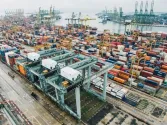
On construction, Maybank raised its 2026 growth forecast to 7%, from 6% previously, after 11.8% growth in the first quarter. It pointed to a pipeline including Changi Terminal 5, Tuas Megaport, the North-South Corridor, the Jurong Island expansion and newly announced works at Changi Terminal 3 and Marina South, adding that government cost-sharing schemes were cushioning rising bitumen and diesel costs and that the government retained ample fiscal capacity if more support was needed.
Maybank said these two tailwinds were behind its decision to raise its GDP growth forecast to 4.6% in 2026, above the Ministry of Trade and Industry's official range of 2% to 4%, easing to 3.1% in 2027, following 6% growth in the first quarter.
However, Maybank warned that a collapse of a short-lived US-Iran truce could restart the Gulf War and disrupt energy supplies. It also warned that high US inflation could trigger aggressive tightening by the US Federal Reserve, which it said could translate into higher interest rates in Singapore.
The bank said the sectors most directly exposed to the Gulf War, like petroleum, petrochemical and land transport, make up just 2.1% of nominal GDP. It added that diversified energy sources, reserve inventories and GasCo's forward LNG procurement had cushioned energy shocks to date, whilst marine shipping, aviation, transport engineering and finance had benefited from a diversion of demand.
Safe-haven flows into foreign currency and Singapore dollar deposits had also supported loan growth and banking liquidity, Maybank said, and it forecast the three-month SORA would end the year at 1%, assuming the Fed holds rates steady.
Maybank expects the Monetary Authority of Singapore to hold its current modest S$NEER appreciation stance through 2027, forecasting core and headline inflation averaging 1.7% in 2026 and 1.6% in 2027, at the lower end of the MAS's 1.5% to 2.5% range, on a strengthening Singapore dollar, a softening labour market and lower energy prices.
Its FX team forecast the Singapore dollar holding at 1.285 against the US dollar by end-2026, similar to end-2025 levels.
























 Read Here
 Advertise
 Sign Up