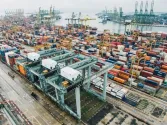
Singapore-India corridor may spur green fuel bunkering
The digital side of the deal could improve port operations.
Singapore and India’s green and digital shipping corridor is expected to create opportunities for clean-fuel bunkering and infrastructure as the maritime sector prepares to align with the International Maritime Organization’s (IMO) target of net-zero emissions by 2050.
Shahrin Osman, business development director for maritime advisory at Norway-based classification society DNV, said India’s renewable energy capacity of 234 gigawatts, based on Rystad Energy’s July report, positions it to produce zero- or near-zero-emission fuels.
“They have that ability to produce zero or near-zero fuels… that gives an opportunity to this ecosystem to look at how they could use this green and digital shipping corridor to enter into this alternative fuel bunkering,” he told Marine & Industrial Report.
Singapore and India signed a deal in early September to establish the Singapore-India Green and Digital Shipping Corridor. The partnership seeks to develop infrastructure and technologies that support low-emission fuels and enable digital information exchange between ports.
Osman said alternative fuel bunkering could spur industries around fuel storage and supplier services.
“When you have the ability to provide that, then the port will become more attractive,” he said via Zoom. “Even though they may not have cargo, load or discharge, if there is a competitive supply of cleaner fuels, then the vessel will call the port to get that supply.”
The partnership comes ahead of the IMO’s adoption of its Net-Zero Framework, which introduces penalties for ships that fail to meet emission targets. From 2028 to 2030, fees will be set at $100 per tonne of carbon dioxide equivalent for ships near compliance and $380 per tonne for those further off-target.
Osman said such rules would push ship owners to adopt alternative fuels rather than pay penalties.
Beyond fuels, the corridor also opens the door for shore power supply at ports, where ships plug directly into clean electricity. Osman said this could be four times more efficient and cheaper than producing synthetic e-fuels.
Goh Puay Guan, associate professor at the Department of Analytics and Operations at the National University of Singapore, said the digital side of the agreement could improve port operations.
“Digitalisation is an opportunity for improving efficiencies and cost effectiveness, which could be served by companies in supply chain visibility, artificial intelligence, data analytics, robotics and automation, that are able to customise these tools for the maritime industry,” he said in an emailed reply to questions.
Osman said ship owners could also integrate energy-saving technologies such as wind-assisted propulsion systems (WAPS). These can reduce fuel use and emissions by as much as 40%, though they require at least $500,000 in upfront costs per vessel, DNV said in a report in March.
About 50 commercial ships were equipped with WAPS as of January, with more orders expected.
Solar panels are another option, though their contribution is typically limited to a 2% reduction in fuel consumption due to space constraints on vessels, according to the report.
Osman cited Norway’s Green Shipping Programme as a model, with 19 of 53 pilot projects producing low- or zero-emission solutions since 2015.
Goh added that the Singapore-India corridor could expand to include other countries and broaden its coverage in the future.























 Read Here
 Advertise
 Sign Up